Digital Receipts: How to Create Touchless, Sustainable Checkout
Listen to this article
Digital receipts are trending in EMEA. They meet consumer expectations for fast, touchless checkout experiences and align with their commitment to sustainability. Digital receipts also help customers track their spending and easily access proof of purchase stored in their digital wallets or shopping apps. For retailers, digital receipts reduce the number of maintenance operations due to printers, and they allow businesses to keep searchable receipt data to confirm items during returns or exchanges and to settle disputes. With regulations requiring a shift to digital rather than paper receipts, retailers will benefit from a move to this technology for compliance as well as for enhanced customer experiences and operational efficiency.
Digital receipts are trending in EMEA. IndustryARC predicts the market will reach $933.06 million by 2030, growing at a 7.0% compound annual growth rate (CAGR) from 2023 to 2030. This growth is, in part, due to regulations, like France’s Loi Anti-Gaspillage (AGEC Law), which prohibits automatic paper receipt printing for most payments, and the evolution of Germany’s Bonpflicht, which is transitioning from mandatory paper receipts to digital receipts by 2029. However, the demand for touchless experiences, sustainable checkout, and more convenient experiences is also driving digital receipt adoption.
How Digital Receipts Support Touchless Checkout Experiences
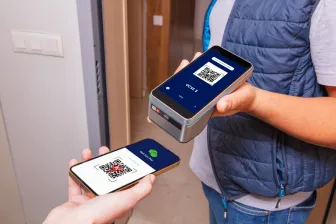
EMEA is a growing tap culture. The European Central Bank reports that consumers made 29.6 billion contactless payments in the first half of 2025, up 12.8% from the previous year. With consumers opting for a “tap-and-go” payment experience, requiring cashier interaction to receive a paper receipt slows down the process. When a retailer implements digital receipts along with contactless payments, they can create a fully touchless flow.
The preference for no-touch transactions is about more than low friction and speed. In certain high-volume areas, customers prefer not to touch a shared device or a receipt that another person handled. Although hygiene, which drove touchless checkout processes during the COVID-19 pandemic, is no longer the primary driver for touchless experiences, it is still a factor for health-conscious consumers.
How Digital Receipts Support More Sustainable Operations
The European Union reports that 83% of consumers say the impact their purchases make on the environment is an important factor in their decision-making. They recognize that sustainability isn’t only related to the products they buy. Sustainable choices also include which brands they support. A retailer’s business practices can decrease (or increase) its carbon footprint.
Retailers who offer digital receipts reduce their paper usage, which helps to conserve natural resources and reduce greenhouse gas emissions. Using less paper also means less waste is bound for landfills. Additionally, because digital receipt solutions eliminate the need to routinely print paper receipts, retailers can use fewer printers, reducing energy consumption. Printers also need parts replacement, occasional repair, and end-of-life processes. It all takes energy, raw materials, manufacturing, and disposal that have negative effects on the environment, which a transition to digital receipts eliminates.
Digital receipts also overcome the challenge of the chemicals, bisphenol S (BPS) or bisphenol A (BPA), often used in thermal receipt paper. Ecology Center reports that these chemicals are potentially detrimental to human health in several ways, and they can be absorbed through the skin. Transitioning to digital receipts from receipts printed on thermal printer paper eliminates this risk.
Digital Receipts Impact on Customer Experiences
While fast, touchless experiences and sustainable checkout processes are important to consumers. Digital receipts also offer shoppers additional advantages. First, digital receipts are easy to find. While consumers may misplace or lose a paper receipt, digital receipts are a few taps away when they’re working on their budgets, making a return, or looking for warranty details. A retailer can send the receipt via email, SMS, or to the shopper’s app. Some systems enable the customer to receive and store digital receipts in their mobile wallets, keeping all purchase records in one place.
Paper receipts can also put customer privacy at risk. Although card or account data is generally masked, the receipt often includes a description of what the customer purchased, available rewards points, or other information the consumer may not want other people to see. Only the customer can see a digital receipt.
How Digital Receipts Support Operational Efficiency
Although digital receipts appeal to consumers and allow retailers to comply with regulations related to paper use and giving customers proof of purchase, they can also benefit retailers operationally:
A Receipt Solution for Line Busting
Retailers using mobile point of sale (mPOS) to assist customers in the aisles need a mobile printer or shared printer on the sales floor to provide printed receipts. That often requires investment in an additional device, and it may mean an extra device for sales associates to carry. Digital receipts streamline the process and eliminate the extra printer investment.
No Printer Maintenance
Receipt printers can require some maintenance to prevent jams or damage. And if a jam occurs, it can slow down checkout and negatively impact customer experiences. On an enterprise scale, transitioning to digital receipts allows a retailer’s IT team to manage fewer maintenance operations linked to printers.
Digitized Processes
Like their customers, retailers can keep copies of digital receipts for easy retrieval if there’s a dispute, chargeback, or when a customer attempts to make a return or exchange without proof of purchase. Digital receipts can also sync with loyalty rewards programs and order history to break down data silos, ensure accuracy, and enhance customer experiences.
Paper Receipts vs. Digital Receipts Summary
Overall, compared to paper receipts, digital receipts show clear advantages:
|
Checkout Feature |
Paper Receipts |
Digital Receipt |
|---|---|---|
| Speed | Add a step to checkout processes | Enable payment and receipt presentation in one flow |
| Touchless, hygienic | Require a handoff or touching a device | No touch; creates a totally hygienic way to get a receipt |
| Sustainable | Paper use, waste generation | No paper use, no waste created for landfills, no electricity to run printers; data center servers energy |
| Digital data for the customer | No digital copies; receipts easily lost or misplaced | Receipts stored in the shopper’s smartphone app, email, or digital wallet |
| Privacy | Anyone can read a paper receipt | Only the customer can see a digital receipt |
| Digital data for the retailer | No receipt data easily available digitally | Searchable, digital records to settle disputes, chargebacks, or returns |
| Mobile POS and line busting | Requires a mobile or shared printer | Seamless receipt delivery without delays during checkout |
| IT maintenance efficiency | Routine printer maintenance, occasional troubleshooting, repair, or replacement | No printers to maintain; data center servers to maintain |
Transform Checkout with Touchless, Sustainable Digital Receipts
The shift from paper to digital processes is in demand from consumers and regulators. A digital receipt solution, particularly one that seamlessly integrates with an Android POS system, can meet that demand seamlessly, enhance customer experiences, and increase operational efficiency.
To learn more about payment solutions for retail with integrated digital receipts, or other ways to operate more competitively, contact us.
FAQs
Digital receipts instantly upload each sale to a secure cloud portal, giving merchants a single, searchable source of truth. This enables real‑time reconciliation, easy export to back‑office systems, and powerful analytics for pricing, inventory and staffing decisions. It also reduces paper costs, improves fraud protection, meets compliance retention, and supports sustainability goals—making digital receipts a key driver of a data‑focused merchant strategy.
Digital receipts are designed to respect customer consent and privacy by only collecting the minimal data needed to deliver the receipt (e.g., a QR‑code link, optional email or SMS address) and never storing persistent personal identifiers unless the shopper explicitly provides them. All receipt data is kept in a secure, GDPR‑certified cloud where PANs are masked and the information is retained solely for transaction proof, with local data‑residency options available where required. Merchants can use the captured contact details for personalised offers only after the customer has given explicit opt‑in, ensuring full compliance with GDPR and giving shoppers direct control over how—and whether—their receipt is delivered.
Digital receipts streamline a multi‑store operation by eliminating paper handling and centralising transaction data. Merchants no longer need to print, store or manually file receipts at each location; instead every sale is captured instantly in a secure online portal that supports real‑time reporting and reconciliation across all stores. The solution also offers flexible delivery (QR‑code, SMS or email), so staff can issue receipts without extra hardware, and the cloud‑based archive provides instant access to historic transactions for audit or dispute resolution. Together, these features cut printing‑and‑storage costs, reduce manual admin work and give merchants a single, searchable view of sales across their entire network.
Digital Receipts advance sustainability by removing paper receipts, cutting raw‑material use, waste and the carbon footprint of printing and handling. The solution delivers receipts instantly via QR‑code, email or SMS, providing a secure, paper‑free alternative that lowers operational waste and helps merchants meet their ESG targets.
Digital receipts keep checkout speed intact—only a tiny, almost invisible step is added, and when the receipt is delivered via QR‑code the impact on transaction time is negligible. By generating the receipt instantly on the terminal, delivering it via a quick QR‑code scan, and handling storage asynchronously in the cloud, Digital Receipts add only a barely perceptible step—keeping the checkout experience fast and seamless.