Switch Point Magazine Highlights Payment Solutions for Retail
Listen to this article
Ingenico’s Switch Point magazine for EMEA retailers provides a snapshot of global payment trends, generational trends shaping EMEA commerce, and the importance of an omnichannel payments ecosystem. It also includes success stories of payment technology implementations that enhance customer experiences and increase efficiency.
Ingenico has launched a new resource highlighting the latest payment solutions for retail in Europe, the Middle East, and Africa (EMEA): Switch Point magazine. “Switch Point” is a term that Ingenico uses to indicate the point at which innovation shifts to execution, the moment payment solutions for retail “switch on.” The first addition of the magazine focuses on global retail trends, consumer expectations in EMEA, and use cases that show the real-life impact of modern payment solution implementation on businesses in various retail segments.
A Snapshot of Payment State of the Art Around the World
For years, retailers have ideated, discussed, and planned for digital transformation, but now, it is happening. Each day, more retailers are taking steps toward their goals of commerce reimaged and frictionless, invisible payments. However, progress is advancing in different ways based on priorities in different global regions. In North America, for example, the focus is on scalability and centralized management. In the APAC region, the leading edge comprises sophisticated digital ecosystems and super apps. In EMEA, retailers are building ecosystems to enable commerce in a mosaic of local and regional standards and consumer demands.
Generational Trends Shaping Commerce in EMEA
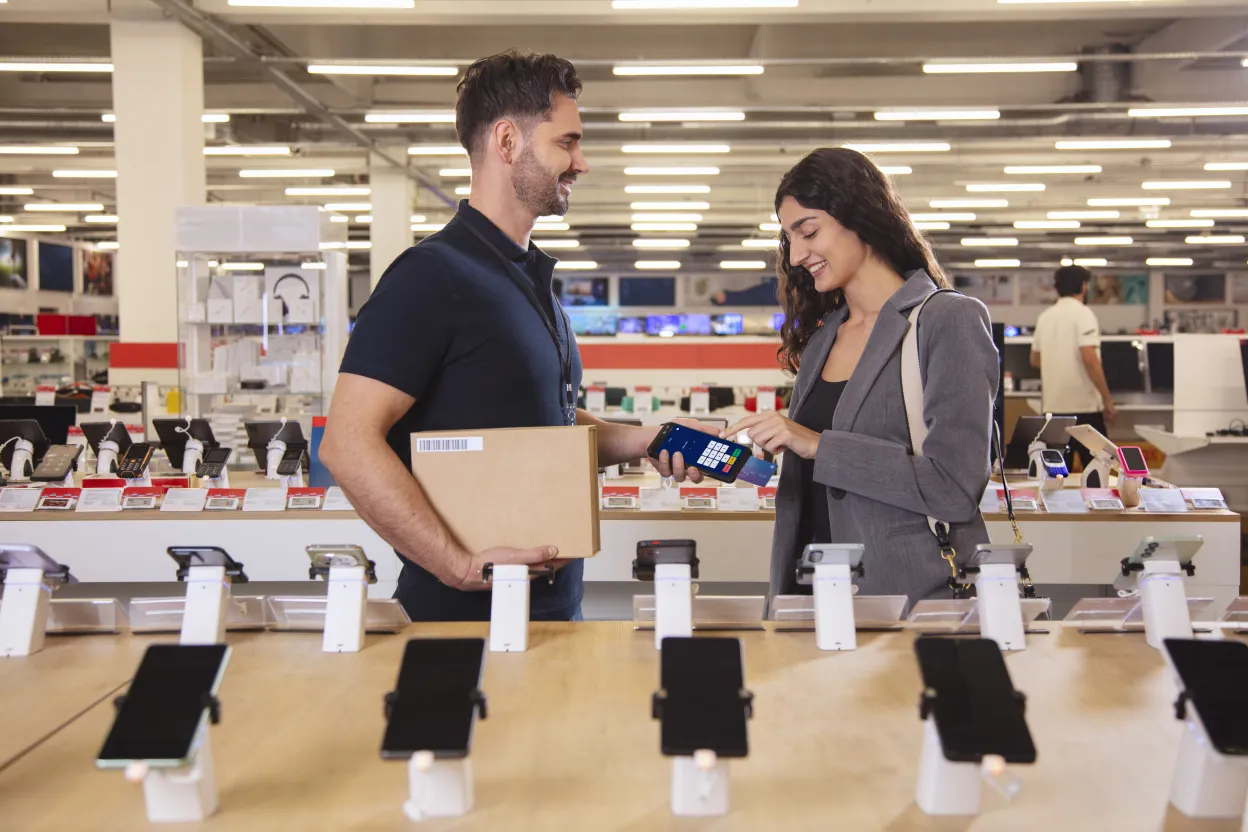
In the consumer-driven retail space, brands must meet their customers’ expectations at the checkout to maximize customer satisfaction and build loyalty. What constitutes a positive payment experience is directly related to generational trends. As Gen Z joins millennials as the dominating force among EMEA consumers, retailers must address their demands. This includes contactless payment acceptance, particularly via mobile wallets, which keeps queues short and boosts customer satisfaction scores.
Secure payments are another expectation among EMEA consumers. Strong consumer authentication (SCA), now a standard in Europe, has made strides to decrease fraud. However, consumers want retailers to solve the puzzle of securing transactions without sacrificing convenience. As a result, biometric payments, especially palm vein recognition-based payments and AI-powered fraud protection, are gaining momentum in several EMEA markets.
Additionally, sustainability factors into EMEA consumers’ shopping decisions. They request digital receipts rather than paper and may favor retailers that offer green options. Besides capturing customer loyalty for sharing their market’s commitment to environmental preservation, retailers can also leverage digital receipts for customer engagement, combining loyalty program information, product details, and payment data into one convenient interaction.
Creating an Omnichannel Payments Ecosystem
EMEA consumers use all points of engagement with retail brands, from ecommerce websites, apps, self-service kiosks, and mobile point of sale (mPOS) to assisted checkout in the store. Retail success depends on delivering consistent experiences regardless of how they choose to shop. Payments can be the link that helps retailers recognize customers as they move from channel to channel so that they can tailor and streamline interactions.
Building a connected system on a foundation of payments also allows retailers to understand omnichannel customers better. Analyzing data from all revenue streams of their businesses allows retailers to forecast more accurately and make informed decisions that keep their businesses on track for growth and profitability.
Payments Solutions for Retail Success Stories
The inaugural issue of Switch Point magazine includes use cases from some retail sectors that show how executing payments innovation is helping retailers achieve their business goals.
-
Jewelry and Luxury: Mobile and secure payments enable personalised, high-touch service, replacing an inconvenient and time-consuming wait at the checkout. This retailer implemented an end-to-end, in-store Android POS and payment system that covers every milestone on the shopper’s journey. The system also includes centralized management and automated updates for security, reliability, and adherence to store policies without adding complexity.
-
Table Service Restaurants: Payment is a key moment in restaurant dining experiences. However, traditional processes require servers to make several trips to the table and can add time and frustration to customer experiences. Pay-at-the-table solutions allow guests to pay immediately upon receiving their checks, creating a smoother, more comfortable experience. Restaurants also benefit from more server productivity and faster table turns.
Key Takeaways from Switch Point
As you read the articles in Switch Point, you’ll see that leading retailers no longer view payment technology as purely transactional tools. They recognize the role it can play in connecting systems and data and increasing customer engagement and satisfaction throughout their organizations. You’ll also see that well-planned payment technology implementation will reduce complexity, enable agility, and accelerate progress toward business goals, the switch point between innovation and execution.
To learn more about the payments switch point in EMEA, as well as Ingenico’s strategy for bringing solutions to market to meet the demand for payment innovation in Europe, the Middle East, Africa, and around the world, download your copy of Switch Point.
FAQs
Biometric payments are payment experiences that use a person’s unique biological traits—such as a fingerprint, palm‑vein pattern, facial features, or iris—to verify identity and authorize a transaction. Instead of a PIN, password, or card swipe, the biometric data is captured at the point‑of‑sale (POS) and matched against a secure template, instantly confirming that the shopper is the rightful owner of the payment method.
To follow security requirements, the software update or download to a terminal must be done by the maintainer. Please contact your local payment provider if needed.
EX and DX are part of the AXIUM portfolio, each device within the EX range is tailored for businesses that prioritize mobility and do not require a printer, such as food trucks or delivery services. On the other hand, the devices in the DX range cater to merchants needing portability along with receipt printing, while still offering the full suite of connectivity options.
Android provides a modern and flexible environment for payment applications and business services. Combined with the Next-Gen AXIUM platform, it enables intuitive user experiences, seamless application integration, remote software updates, and the flexibility to support evolving payment and business needs.