EMEA Retail Trends Revolutionizing Checkout Experiences
Listen to this article
Several retail trends in EMEA are related to improving customer experiences at the checkout. Retailers are exploring or implementing cashierless or self-service options. Brands are also allowing customers to seamlessly move from physical to digital engagement, and they’re personalizing experiences for greater customer satisfaction and, as a result, growing revenues. Flexible, modern payments are key to aligning with these retail trends.
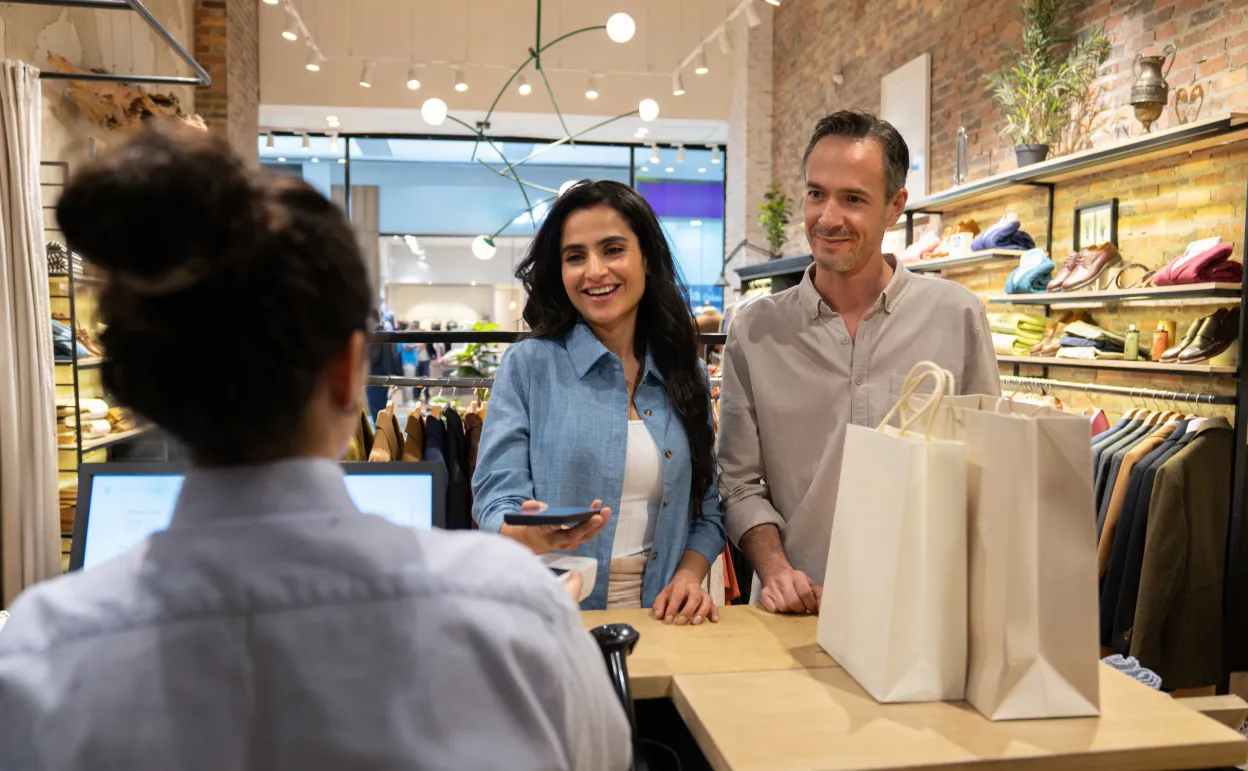
Retail trends are evolving rapidly, driven by changing customer behaviors, new technologies, and a growing need for operational efficiency. Among all the trends gaining momentum in the retail space, some of the most impactful are those related to checkout. The checkout is an opportunity to build trust and loyalty with transparency and personalization. It’s also the last point of interaction during a purchase, which can leave the customer with a positive impression of a retail brand, or, unfortunately, a negative one. So, elevating checkout experiences has become a priority for competitive brands determined to meet customer expectations and win their business.
How Checkout Experiences Are Evolving
Retail trends include giving customers more autonomy in their shopping journeys, removing checkout friction, and elevating payment experiences. So, retailers are moving toward cashierless checkout, self-service, immersive omnichannel experiences, and hyper-personalization.
Cashierless Technology
Systems leveraging infrared (IR) cameras and sensors identify the products customers put in their baskets, total the sale, and send a receipt to the customer’s smartphone. It’s quick and convenient for shoppers because customers don’t have to wait in a queue to pay. Leaders of Trade reports that Poland is a leader in Europe’s cashierless landscape, with Zabka Polska successfully operating a chain of autonomous convenience stores. Other chains throughout EMEA are considering or piloting similar models.
Self-Service
Self-checkout stations, where customers scan their items and pay without a cashier’s assistance, are becoming more common. The EHI Retail Institute reports that self-checkout implementations in Germany have more than doubled from 2023 to 2025. More than 11,000 stores give their customers the option to check out on unattended payment solutions or use their mobile devices to scan products as they shop, saving time and eliminating repackaging at a checkout counter. Grand View Research reports that, across Europe, the self-checkout system market will grow at a robust 14.3% compound annual growth rate (CAGR) from 2026 to 2033 and reach over €4,091 million. Many retailers are considering or implementing self-checkout and self-service systems, paying special attention to reliability, ease of use, and loss prevention.
Omnichannel, Phygital Experiences
The number of consumers engaging with brands via ecommerce continues to rise. For example, research by the B2C eCommerce and Digital Innovation in Retail Observatories of the School of Management at the Polytechnic University of Milan found that ecommerce in Italy reached €62.3 billion in 2025, a 7% increase over 2024. It now accounts for 13% of retail sales. Throughout Europe, according to the European Commission, turnover is even higher, reaching 19.49% of retail sales in 2024. Consumers who have grown accustomed to ecommerce expect in-store experiences to provide the same degree of convenience, accessible information, and personalization that they find when they shop online. Furthermore, they expect brands to recognize them whether they shop in-store or on digital channels, and they want seamless omnichannel experiences, like click-and-collect and in-store returns of online purchases. Retailers are taking a “phygital” approach, blending physical and digital commerce and allowing shoppers to move seamlessly between channels.
Data-Driven Personalization
Another retail trend is personalizing checkout for each customer. Retailers can use data from their point of sale (POS) systems, ecommerce platforms, loyalty schemes, and other sources to understand their customers and tailor service. Artificial intelligence (AI) offers retailers a solution for analyzing data instantly and personalizing messaging, remembering the customer’s preferences, making relevant offers via digital coupons, and incentivizing future purchases with personalized communications on digital receipts.
New Staff Roles
Giving customers more autonomy in shopping experiences and automating processes allows retailers to allocate employees to perform higher-value tasks. Frontend staff are transitioning from transactional roles to becoming customer engagement specialists. By focusing on customer satisfaction, being available to answer questions, and resolving one-off issues, retail staff can build stronger customer relationships and stronger revenues.
Growing Retail Trends Depend on Modern Payment Experiences
Each of these retail trends depends on brands’ ability to accept customers’ preferred payment methods. Retailers will gain an edge from implementing modern, flexible Android payment terminals, which allow them to accept the full range of payments, from traditional credit and debit to alternative payments, like QR code payments, buy now, pay later (BNPL), and even cryptocurrency.
Brands will also benefit from working with a payment technology company that provides payment solutions for retail at all points of engagement, from a checkout counter to unattended payments and mobile devices. A comprehensive, agile line of Android POS terminals also allows retailers to craft experiences that align with current retail trends and adapt as the retail and payments industries continue to evolve. For instance, implementing payment terminals now that can adapt to accept palm vein recognition payments, securely and efficiently, will allow retailers to keep pace in the future by simply adding a peripheral biometric payment device.
This transformation is also evident across major European markets. In Spain, retailers are rapidly adopting modern payment technologies to support evolving checkout experiences. According to insights from CBRE, the recovery in physical retail and increased footfall are driving demand for faster, more flexible payment options, reinforcing the need for seamless, technology-enabled checkout solutions.
In the UK, payment innovation is even more advanced. According to the NFCW, contactless payments now account for over 94% of eligible in-store card transactions, highlighting how frictionless, tap-and-go experiences have become the standard at checkout. This widespread adoption is accelerating the shift toward fully integrated, omnichannel payment ecosystems.
Meanwhile, in France, improvements in retail fundamentals and rising footfall across physical stores are reinforcing the importance of modernizing in-store experiences, including payments. According to CBRE, retail footfall across Europe is approaching or exceeding pre-pandemic levels, supporting continued investment in seamless, technology-enabled checkout solutions.
Digital payments in Italy are expanding rapidly: according to Osservatorio Innovative Payments, 45% of consumer spending was made electronically in 2025, reaching €518 billion (+7% vs. 2024) with + 11% for contactless payments. In-store, smartphone and wearable payments continue to rise. At the same time, AI and biometric authentication enhance security and increase authorization rates. Finally, digital investments in Retail reached 4.7% of retailers’ revenue in 2025, up from 3.2% in 2024 (+57%).
Aligning with Today’s Retail Trends Is Not Optional
Change in retail is accelerating, and brands that don’t move forward with the industry will fall behind their competitors who do. Retail trends at the checkout are shifting from mere transactions to customer-engaging, loyalty-building experiences. Retailers focused on success will evaluate self-service options and cashierless systems that eliminate waiting in a queue to pay. They’ll also explore technologies that allow them to personalize experiences and blend online and in-store shopping.
Ingenico has launched its Next-Gen AXIUM line of Android payment terminals, which empower retailers to run business applications on these devices to unify loyalty, discounts, digital receipts, and more into a single flow at the checkout. Next-Gen AXIUM is also AI-ready, serving as the point of interaction between AI services and in-store systems, allowing retailers to personalize and enhance checkout.
For a glimpse of the future of retail, you only need to look at retail trends to see the direction the industry is moving. Ingenico offers future-ready point of sale and payment technology. Contact us to learn more.
FAQs
Next-generation Android payment terminals help small businesses deliver a modern payment experience while benefiting from the latest platform innovations. Features such as intuitive user interfaces, advanced security standards, remote software updates, and support for business applications help simplify daily operations and provide the flexibility to adapt to changing customer and business needs.
Android provides a modern and flexible environment for payment applications and business services. Combined with the Next-Gen AXIUM platform, it enables intuitive user experiences, seamless application integration, remote software updates, and the flexibility to support evolving payment and business needs.
Ingenico, in collaboration with Fujitsu Frontech North America Inc., presents an advanced Palm Vein Biometrics solution that revolutionizes authentication processes. This innovative technology utilizes near-infrared light to capture and analyze the intricate vein patterns unique to each individual's palm. By employing Fujitsu's cutting-edge PalmSecure sensor technology, the solution ensures highly accurate and secure identification, surpassing traditional methods like passwords or PINs.
The Palm Vein Biometrics solution from Ingenico and Fujitsu Frontech North America offers several key benefits. It provides an exceptionally high level of security, as palm vein patterns are virtually impossible to replicate, ensuring protection against fraud and unauthorized access. Moreover, this non-invasive technology offers a seamless user experience, with fast and reliable authentication in various environments such as retail, banking, and healthcare.
For more information about Ingenico's Palm Vein Biometrics solution, please read the press release and learn more about its first pilot deployment at Tienda Inglesa’s Red Expres in Uruguay.
Ingenico provides a comprehensive suite of Retail POS solutions designed to streamline transactions, enhance customer experiences, and support every payment method.
- Integrated POS: The All-in-One Smart Solution
Ingenico’s integrated POS solution, the AXIUM CX9000, seamlessly combines payment acceptance and business management in a single device. With a built-in cash register and payment terminal, the AXIUM CX9000 streamlines operations, boosts efficiency, and delivers a frictionless checkout experience.
- Retail PIN Pads: Secure, Versatile, and Built for Retail
Ingenico offers a full range of retail PIN pads designed to integrate seamlessly with any checkout system. These devices support all major payment methods, including contactless, chip & PIN, mobile wallets, and QR codes, ensuring a smooth and secure transaction experience. Built for speed, durability, and ease of use, they enhance customer interactions at the point of sale while maintaining the highest security standards. Explore the range.
- Printerless POS: Mobility Without Compromise
The AXIUM EX8000 is a compact, printerless smart POS designed for modern retail environments. With built-in barcode scanning, seamless support for all payment methods, and easy integration with value-added services like inventory management, it enhances mobility and checkout efficiency for businesses.
- Ingenico SoftPOS: Tap & Pay with Any Android or iOS Device
Ingenico SoftPOS is a flexible software-based solution that transforms any Android smartphone or tablet into a contactless payment terminal. This innovative technology allows businesses to accept payments anywhere without additional hardware, making it an ideal add-on for in-store mobility, allowing sales associates to assist customers anywhere and reduce queues, while accepting contactless payments with no extra hardware. With security and compliance at its core, SoftPOS delivers a frictionless, cost-effective way to modernize the checkout experience.
- Unattended Payment Solutions: Secure Self-Service Transactions
Ingenico’s unattended payment solutions enable businesses to offer self-service transactions in retail, hospitality, transportation, and other industries. These robust, weather-resistant payment terminals support contactless, chip & PIN, and mobile wallets, ensuring secure and frictionless payments in vending machines, kiosks, and unattended retail environments.
Accept payments anytime, anywhere, on any device. Upgrade your checkout experience with Ingenico’s Retail POS solutions. Discover more here.
Ingenico self-service terminals are designed to handle a full spectrum of payment types to accommodate local and international customer preferences
Supported options (depending on model) include:
- EMV Chip & PIN, compliant card transactions.
- Contactless/NFC payments from cards, phones, smartwatches, and wearables (Visa, Mastercard, Amex, Apple Pay, Google Pay, Samsung Pay, etc.).
- Magstripe (on models with hybrid readers) for legacy acceptance.
- QR code-based payments via integrated or optional camera
- Open-loop and closed-loop transport cards for transit and mobility services.
Payment method acceptance varies by terminal model, allowing configuration to match specific use cases and regional payment preferences.