Do Biometric Payment Solutions Give Retailers a Competitive Edge?
Listen to this article
Retailers should consider accepting biometric payments and gaining an early adopter advantage in the new world of commerce. This method uses a consumer’s physical traits to authenticate payments, with palm vein scans emerging as the best option for ease, privacy, reliability, and security. Successful implementations around the world confirm that this payment method is practical and has benefits, from shorter wait times at the checkout to less fraud and fewer chargebacks.
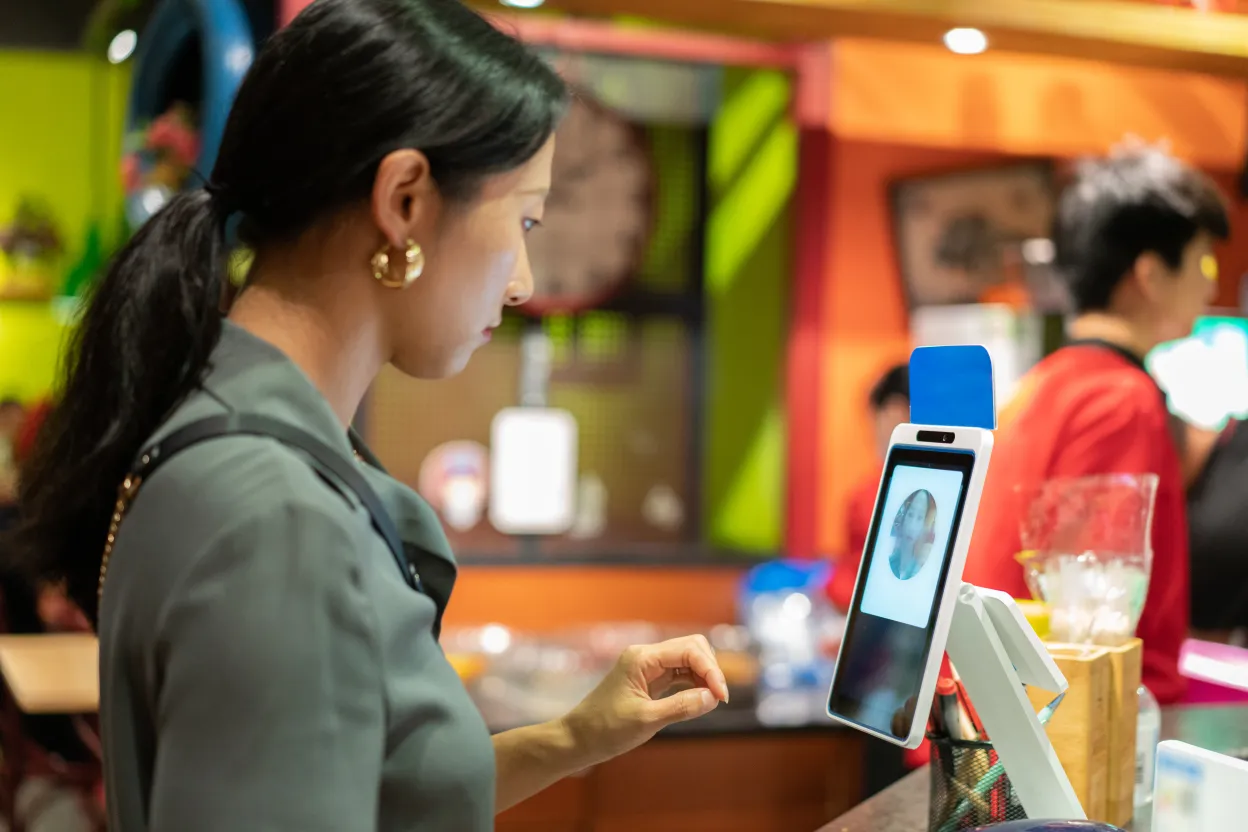
It’s time for retailers to take a serious look at biometric payments. This payment method can attract younger consumers and enhance experiences for existing customers, helping businesses to gain a competitive edge.
What is Biometric Payment?
Biometric payment uses a consumer’s physical traits to authenticate identity. It uses stored biometric data, such as a fingerprint, facial scan, palm vein map, or voice, to confirm the person making a payment is authorized to do it. Consumers don’t need to carry or use payment cards or even smartphones with mobile wallets. They don’t have to take extra time at the checkout to find payment cards in a purse or open a mobile wallet while impatient people wait behind them. Biometric payment is fast and frictionless.
Why Is Palm Vein Payment the Best Option?
Acquirers can offer different types of biometric payment solutions. However, palm vein biometric payment has emerged as the leading method to capture payment data due to privacy, reliability, and ease. Palm vein scanning is:
-
Touchless
Unlike fingerprint scans, palm vein scanning does not require the consumer to touch a device. Consumers hold their hands over an infrared scanner to create a map of their palm veins that the system will later use to authenticate their identities. Consumers appreciate a touchless experience, eliminating the worry of picking up germs from a shared device. Dirt or oil from touching a screen can lead to bad reads and a delay at checkout.
-
Security and Privacy
It may be possible for a bad actor to “lift” a fingerprint from a shared device and use it to make a fraudulent payment, but palm veins cannot be counterfeited. Palm vein scans are also private. A cashier or person standing nearby cannot see a consumer’s palm vein map. It’s only visible with an IR scan. The system matches it to the palm vein map the consumer created when enrolling.
-
Trustworthy
A GetApp survey found that confidence in facial scans in retail applications has dropped from 50% in 2022 to just 25%, due to misidentification and bias, particularly among people of color and women. Palm vein scans are reliable.
-
Consistent
The pattern of a person’s palm veins doesn’t change with age or injury, like a person’s voice or, sometimes, fingerprints.
|
Biometric Payment Method Feature |
Fingerprint |
Facial Scan |
Voice Recognition |
Palm Vein Scan |
|---|---|---|---|---|
| Touchless |
× |
✔ |
✔ |
✔ |
| Private, others cannot see or hear |
✔ |
× |
× |
✔ |
| Unique and unbiased |
✔ |
× |
× |
✔ |
| Doesn’t change with time |
× |
× |
× |
✔ |
(× = not supported ; ✔ = supported)
Is Biometric Payment Secure?
Retailers often ask whether biometric data stored for payment authorization is secure, and with good reason. The Verizon 2025 Data Breach Report states that the retail sector experienced 847 incidents last year, and 419 resulted in data disclosures.
Leading biometric payment solution providers use mathematic algorithms to generate non reversible biometric templates, and they back up these data to ensure it is not vulnerable to theft or data corruption. Retailers never store actual biometric data. It’s used for authentication, and the retailer receives only the payment authorization linked to tokenized card information.
Keep in mind, too, that the payment process itself is more secure. When consumers hold their palms over an infrared scanner, it eliminates the risk of someone watching them enter their PINs or stealing their payment cards. Retail employees never have the opportunity to see payment card numbers or put them at risk. Biometric payments are designed for security and data protection.
Are Businesses Using Biometric Payments Today?
Retailers can find several successful examples of biometric payment programs launched in the past few years in different locations around the world.
Uruguay
Ingenico partnered with Mastercard, Fulcrum Biometrics, Fujitsu Frontech, and Scanntech to enable biometric payments at Tienda Inglesa’s Red Expres in Uruguay. Customers enroll by scanning their palm vein patterns and linking them to their tokenized payment card data. When it’s time to pay, customers hold their open hand over the scanner. The system compares the scan to the image on file and, if it’s a match, processes the payment.
Brazil
Consumers used palm vein payments in a proof of concept test at Cielo’s headquarters in Barueri/SP. In this program made possible through a partnership with Cielo and Ingenico, consumers registered their palm vein patterns and linked them to their Visa or Mastercard credit cards. These consumers paid securely with just scans of their hands.
What Are the Benefits of Biometric Payments?
Businesses that have implemented these innovative payment solutions have seen numerous benefits, including:
-
Faster Payments: Customers spend less time at the checkout and waiting in the queue to pay.
-
Loyalty and Digital ID Integration: Biometric payments can integrate seamlessly with loyalty rewards solutions and digital IDs, combining several steps in the checkout workflow into one wave of the hand.
-
Less fraud: Biometric payments, particularly palm vein scans, are virtually impossible to counterfeit.
-
Fewer chargebacks: With unquestionable consumer identification, merchants see fewer payment disputes.
-
Appeal to younger consumers: Biometric payments’ speed, convenience, and control meet expectations of consumers under 40, according to The Financial Brand.
-
Use cases beyond payments: Retailers who currently use barcodes to confirm self-checkout customers paid can use palm vein scanning to remove friction from the process.
-
Sustainability: Biometric payments are environmentally-friendly, eliminating physical cards and paper tickets or receipts.
The Next Step Toward a Future-Proof Business is Implementing Biometric Payments
Retailers determined to stay on the cutting edge will explore biometric payment options now. Innovative payment solutions, especially those that use palm vein scanning, decrease payment friction, fraud, and wait times at the checkout. As a leader in payment technology, Ingenico offers palm vein payment solutions and will help retailers implement them for the best performance and user experiences. To learn more, contact us.
FAQs
To obtain consent, merchants must ask customers for explicit, opt‑in consent before any personal contact details (e‑mail, phone, marketing preferences) are stored or used. To record consent, consent is logged as a digital record (timestamp, merchant ID, terminal ID) that is searchable for audit and compliance purposes. When a revocation request is received, the platform deactivates the consent flag and purges the associated personal data (e‑mail, phone) while keeping the receipt itself for audit purposes.
Yes – customers can withdraw their consent and still keep the service. Opt‑out removes only the optional contact information; it does not interrupt the merchant’s ability to issue or access digital receipts or any other core payment functionality.
The data is treated as the customer’s personal data, processed after the customer gives explicit consent and, whenever possible, stores it on‑device (local to the terminal or smartphone) rather than in a central cloud. This aligns with GDPR requirements that the data subject retains ownership and control. The authentication decision is performed locally on the POS terminal or the customer’s device (e.g., the palm‑vein sensor or fingerprint module). The terminal validates the biometric sample against the locally stored template and only then authorises the payment. No external party decides the outcome. Merchants get a masked receipt for audit purposes, but they never receive the raw biometric data or the authentication result. The data stays with the customer (or the device) and is deleted if the customer revokes consent.
Yes – the biometric payment solution is designed to scale across multiple regions and sales channels. The solution works in different market ecosystems (bank‑centric, fintech‑centric, merchant‑centric) and can be rolled out wherever a payment rail exists. The same core biometric engine can be localized (e.g., language, UI, compliance) while keeping a single backend. The biometric flow can be used on SoftPOS phones, dedicated terminals, and mobile apps, delivering a consistent experience across all touchpoints.