What Developers Need to Know About Payment Terminals for Small Businesses
Listen to this article
Payment terminals need flexibility to keep up with changing payment trends and consumer behaviors, like the growing use of QR code and bank transfer payments and the growing buy now, pay later (BNPL) market. Acquirers and ISVs serving LATAM small businesses need to meet their needs for reliable, secure, and easy-to-use payment terminals. However, leading payment solution providers will help small businesses gain an edge with Next-Generation Android payment technology that allows merchants to run business apps on their terminals, manage them more easily, and accept payments anywhere.

Acquiring banks and ISVs providing point of sale (POS) solutions for small businesses need to evaluate this market and deliver the payment terminals these retailers need. LATAM is transitioning from cash-based payments toward digital methods, which Thunes forecasts will reach more than USD 300 billion by 2027. Small businesses need to keep pace with modern payment solutions, which allow them to expand the pool of potential customers to both digital-first and unbanked populations.
For instance, small businesses can build loyalty among consumers and capture more revenue if they accept popular Mercado Pago QR code payments. Additionally, 165 million Brazilians now use the Pix instant payment system with their mobile wallets. LATAM is also seeing an increase in buy now, pay later (BNPL) payments, with ResearchAndMarkets.com predicting this market will grow at a 20.9% compound annual growth rate (CAGR) to reach USD 41.7 billion. Small businesses need payment terminals that are capable of accepting these payments, as well as credit, debit, and contactless payments, so they can compete in a changing payments landscape.
3 Things Every Small Business Needs from Payment Terminals
Like larger businesses, small businesses need payment terminals that provide them with expanded functionality, but the value that comes from these three payment device basics is vital for them:
Reliability
Dealing with downtime or troubleshooting a malfunctioning device costs time and money that small businesses can’t afford. Be certain the payment terminals you offer work glitch-free.
Security and Compliance
Both merchants and consumers are concerned about payment data security and personal data privacy. Businesses need devices that meet the latest Payment Card Industry (PCI) standards, including PCI PIN transaction security (PCI PTS), PCI Point of Interaction modular security (PCI POI), and the PCI Data Security Standard (PCI DSS). Devices that meet these standards help keep data (and small businesses) safe.
Ease of Use
Small business employees and their customers aren’t necessarily technology experts. Devices that operate easily will reduce friction and frustration at checkout, enhancing customer experiences. Devices that feature an easy-to-use, “smartphone” experience can reduce training time, helping new employees to quickly feel confident to work independently.
4 Next-Generation Payment Terminal Features that Help Small Businesses Succeed
Beyond payment terminal essentials, acquirers and ISVs can help their small business clients gain a competitive edge with devices that have next-generation features. Android payment terminals running on a comprehensive platform let retailers get more value from their payment device investments, with the ability to run business applications and accept alternative payments, to gaining more visibility into payment terminal performance.
|
Next-generation payment device features |
Benefits to small businesses |
|---|---|
| Smart payment terminal capabilities | Retailers can run business applications on the terminal, like loyalty programs, inventory management, and even POS software. |
| Payment flexibility | Using device-native features like the camera, encryption, and near-field communication (NFC), small businesses can accept the full range of payment methods. |
| Payment terminal management system | Advanced payment terminal platforms give acquirers and ISVs the ability to provide estate management services, including configuration, updates, and remote service to maximize uptime. |
| Mobile POS portability | Small businesses can leverage mobile devices to accept payments anywhere for line-busting and greater customer satisfaction. |
When to Offer Payment Solutions that Require No Payment Terminal At All
Acquirers and ISVs should also think outside the box and consider how to make payment acceptance as easy and cost-effective as possible for small businesses, and, in some cases, that may mean letting these retailers accept contactless payments directly on the mobile devices they already own.
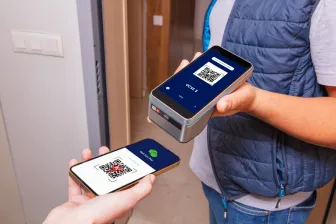
Ingenico SoftPOS transforms NFC phones or tablets into payment devices. This software-based payment solution is easy for retailers to implement. They contact their acquirer and upload an app that allows them to begin accepting payments quickly and securely. Retailers can use SoftPOS to support all major payment methods, including credit, debit, digital wallets, and QR codes that consumers can make with their smartphones or contactless payment cards.
SoftPOS can help small businesses accept more payment methods immediately, without waiting for the budget to invest in payment terminals. It may even be the on-ramp to digital payments for micro-businesses that have been cash-only up to this point.
How Acquirers and ISVs Can Offer Leading-Edge Payment Solutions
In the fast-changing payments landscape in LATAM, acquirers and ISVs must find the most practical, functional, and cost-effective payment devices for small businesses. Ingenico can help you create modern solutions to meet your market’s needs. We offer a wide range of payment terminals supported by our AXIUM Android platform with options for businesses of any size with the reliability, security, ease of use, and flexibility they need. We also offer an industry-leading SoftPOS solution, also supported by AXIUM payment technology, so you can offer all options to small merchants.
Contact us to discuss your market’s needs and how Ingenico can help you meet them.
FAQs
Small merchants need a terminal that is quick to deploy, inexpensive, secure, versatile, and easy to manage remotely. Those capabilities let them accept the full range of modern payment methods, stay compliant, and focus on selling rather than on tech upkeep.
A payment‑terminal management system gives you centralised, secure, and automated control over every device in the field, turning a fragmented, high‑maintenance network into a scalable, cost‑efficient, and merchant‑friendly estate.
Acquirers and ISVs should offer SoftPOS when the priority is speed, cost‑efficiency, mobility, and easy integration—especially for long‑tail merchants, vertical‑specific use cases (hospitality, delivery, pop‑up retail), and when a bank/PSP can use its brand to mitigate security concerns. For high‑volume, fixed‑location stores that need maximum reliability and throughput, a traditional terminal remains the better choice.
Next‑generation payment technology combines open‑finance APIs, instant real‑time transfers, tokenized/embedded checkout, AI‑driven personalization, and Android‑based cloud‑native POS hardware. Together they deliver faster, safer, and more seamless commerce across every channel—online, in‑store, and in‑the‑field.
Android‑powered payment technology is the backbone of a future‑ready checkout because it turns a traditional terminal into a flexible, updatable commerce hub. Ingenico’s AXIUM platform leverages Android to deliver a durable, high‑performance POS that can run a wide ecosystem of apps— from core payment processing to loyalty, digital receipts, and value‑added services— all while staying secure and PCI‑compliant through a modular, continuously‑updated OS. This open, developer‑friendly environment lets merchants integrate their own business applications via SDKs and APIs, roll out new features instantly, and adapt to emerging payment methods (e.g., QR‑code, BNPL, SoftPOS) without replacing hardware. The result is a consistent, scalable solution that reduces complexity, accelerates time‑to‑market, and ensures the checkout experience can evolve alongside consumer expectations and regulatory changes.