The History of Payment Terminals: Which Era Are You In?
Listen to this article
Payment terminals have evolved from early data capture and remote data transmission to today’s user-friendly, AI-enhanced devices. Payment terminals, which once used magstripe readers to capture payment data, now communicate with EMV chip cards. Near-field communication (NFC)-enabled terminals allow merchants to accept contactless card and mobile wallet payments. Android-based payment technology also makes it possible to accept the full range of payment methods, including alternative payments. Innovation continues, including using native features of devices, like lighting and haptics, to create accessible, user-friendly experiences.
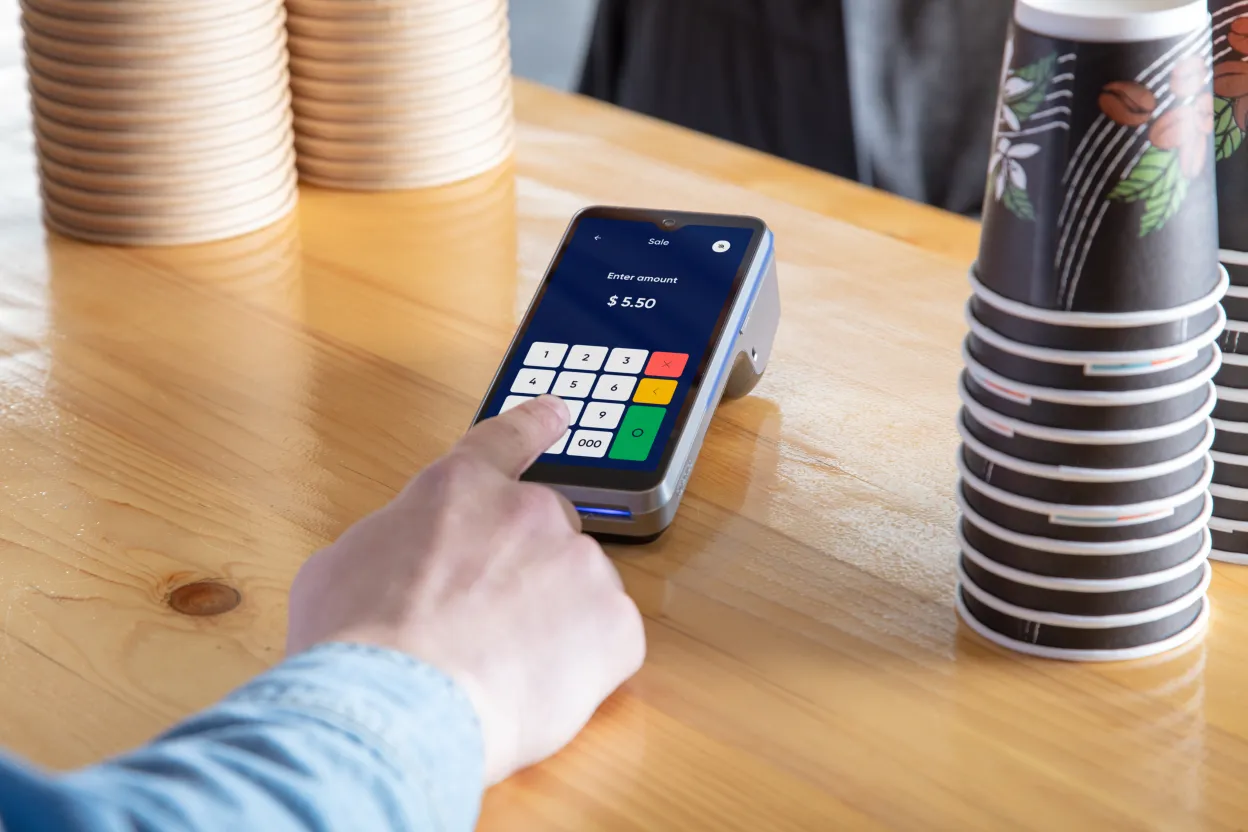
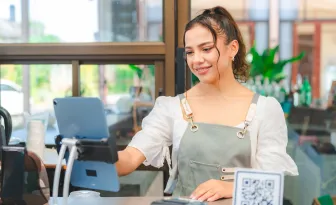
Payment terminals allow merchants to accept digital payments securely and efficiently. They have become commonplace, a fixture on many checkout counters or in the hands of mobile employees in stores, restaurants, and other merchant operations. However, just a few decades ago, accepting a credit card payment was not supported by digital technology. Merchants manually created imprints of credit cards and sent those paper copies to their banks for payment. Manually capturing transaction data was filled with inefficiencies, data exposure, and opportunities for errors. Merchants had to check printed lists of lost or canceled cards and make telephone calls to authorize transactions over certain amounts. Digitizing the process with payment terminals solved those challenges.
A Look Back at the First Payment Terminals
Innovators in the late 1970s and early 1980s developed electronic payment terminals to capture cardholder data. In fact, Ingenico, founded in 1980, launched payment terminals that combined card-reading and remote data transmissions, allowing merchants to handle card transactions more quickly and to keep data, which had been easily human-readable on paper receipts, more secure.
Early payment terminals read data from magnetic stripes (magstripes) on the backs of credit and debit cards. Encoders arranged magnetic particles on these strips that communicated payment data when a consumer or sales associate swiped them through a card reader.
Magstripe transactions were the top method of capturing payment data for about three decades, with IBM reporting more than $7 trillion in credit and debit transactions via magstripe in 2018. However, magstripes are easy to read, and cards were easy to counterfeit, which created a high risk of fraud. In 2014, credit card fraud had increased to $32 billion, up from $23 the previous year. Payment terminals had to evolve to mitigate these losses.
Payment Terminals Expand How They Communicate
The next milestone in payment terminals’ evolution was to increase their capability to communicate with issuing banks and other players in the payment chain. Communication expanded beyond sending cardholder data for processing to alert merchants when the card a customer was trying to use was lost or stolen. This near-real-time method of card authorization helped to stop unauthorized use.
The next step in protecting cardholder data was the transition to EMV (which stands for Europay, Mastercard, Visa). EMV technology uses a chip in the payment card, replacing the magstripe with a way to share data that’s very difficult to counterfeit. However, the chip does more than provide payment terminals with cardholder data. They create a one-time transaction code that validates the transaction. Systems of chip and PIN or chip and signature created even more confidence in cardholder authentication. With the transition to this technology, payment terminals had to evolve to read and interact with EMV chips.
The Transition from “Dipping” to “Tapping” Cards on Payment Terminals
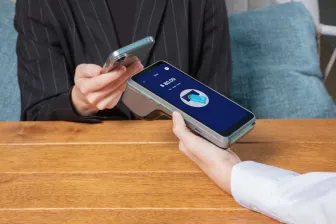
When merchants upgraded to EMV payment terminals, many deployed devices equipped with near-field communication (NFC). This technology allows a terminal to communicate with a card chip or a smartphone with a mobile wallet without contact. The popularity of contactless payments grew, with the Asia-Pacific region (APAC) and Europe leading the way. Mastercard reports that the tipping point was the COVID-19 pandemic that began in 2020, when consumers were concerned about disease transmission when touching shared devices. In Q1 2020 alone, contactless payment use grew by 40%.
Payment Terminals Give Consumers More Payment Choices
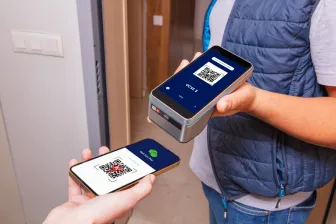
To keep up with consumer demands for payment method choice, payment terminals continued to evolve. The transition from proprietary payment terminal operating systems to Android-based technology opened the door to accepting more payment types, such as QR code payments that allow customers to pay with crypto wallets, payment apps, or buy now, pay later accounts.
Payment technology advancements have also allowed merchants to accept the full range of payments, with or without a traditional payment terminal. SoftPOS allows merchants to accept contactless payments directly on mobile devices they use in their operations for mobile point of sale (mPOS) or inventory management, with no additional payment device required.
Modernizing the Look, Feel, and Functionality of Payment Terminals
As payment technology evolved over the past four decades, so did customer-facing elements of the terminal itself. Instead of “green screen” displays, consumers can now interact with larger touchscreens that provide similar experiences to interacting with a smartphone. Payment technology can also use native features, particularly in Android payment terminals, to enhance payment experiences with lighting and haptic cues, leading to greater accessibility for all users.
Innovations also help protect cardholder data, for example, using machine vision to detect if a person is looking over a customer’s shoulder and going dark until privacy is restored and the customer can safely enter a PIN. Terminals can also support biometric payments, allowing customers to use a low-friction, quick palm vein scan to pay.
Where Do Your Payment Terminals Fall on the Timeline?
Although payment terminals have evolved dramatically, with more rapid innovation in recent years, some merchants are still using technology that was considered “state-of-the-art” years ago. Today’s payment terminals effectively capture and secure payment data. However, they also enhance customer experiences and can even become a part of merchants’ customer engagement strategies.
To stay on the leading edge and make the most of the payment terminals you deploy, contact us to learn about the advanced capabilities of our AXIUM Android payment terminals.
FAQs
Android provides a modern and flexible environment for payment applications and business services. Combined with the Next-Gen AXIUM platform, it enables intuitive user experiences, seamless application integration, remote software updates, and the flexibility to support evolving payment and business needs.
Ingenico, in collaboration with Fujitsu Frontech North America Inc., presents an advanced Palm Vein Biometrics solution that revolutionizes authentication processes. This innovative technology utilizes near-infrared light to capture and analyze the intricate vein patterns unique to each individual's palm. By employing Fujitsu's cutting-edge PalmSecure sensor technology, the solution ensures highly accurate and secure identification, surpassing traditional methods like passwords or PINs.
The Palm Vein Biometrics solution from Ingenico and Fujitsu Frontech North America offers several key benefits. It provides an exceptionally high level of security, as palm vein patterns are virtually impossible to replicate, ensuring protection against fraud and unauthorized access. Moreover, this non-invasive technology offers a seamless user experience, with fast and reliable authentication in various environments such as retail, banking, and healthcare.
For more information about Ingenico's Palm Vein Biometrics solution, please read the press release and learn more about its first pilot deployment at Tienda Inglesa’s Red Expres in Uruguay.
Yes, Ingenico offers Tap to Pay solutions with contactless payments, enabling quick, secure transactions via card or mobile device. Our SoftPOS technology, enhanced by the acquisition of Phos, turns smartphones and tablets into secure payment terminals, eliminating the need for traditional POS hardware. Perfect for small businesses, freelancers, and service providers, our solution combines flexibility, ease of use, and top-notch security.
For detailed product information and pricing, please get in touch with our sales team.
Ingenico is committed to ensuring our payment methods are future-ready by continually innovating and adapting to emerging trends. We achieve this through:
- Continuous research and development: Our dedicated R&D team monitors market trends and technological advancements, ensuring our solutions remain competitive.
- Flexible integration: Ingenico payment methods are designed to easily integrate with evolving technologies, allowing for seamless upgrades and expansions.
- Support for multiple payment methods: We stay ahead of the curve by supporting a wide range of payment options, including contactless payments, mobile wallets, and alternative methods, ensuring your business can adapt to changing customer preferences.
Discover how Ingenico's innovative payment solutions can future-proof your business. Contact us today to learn more!