SoftPOS in 2026: New Rules, Higher Expectations and the Right Device for Every Checkout
Listen to this article
For most of its short history, SoftPOS has played a supporting role. Banks and acquirers offered it to micro-merchants who were not yet ready for a terminal, and larger retailers kept a few payment-enabled phones on hand for queue-busting, seasonal peaks or pop-up events.
That role is expanding. In 2026, more merchants and payment providers are asking SoftPOS to take on everyday payment acceptance for mobile staff, delivery teams and service businesses, not just occasional edge cases. The industry is responding with rules to match. EMVCo and the card schemes are paying closer attention to how well phones and tablets read contactless cards, PCI Mobile Payments on COTS (MPoC) is becoming the single security standard for payment acceptance on commercial off-the-shelf (COTS) devices, and merchants increasingly expect SoftPOS to deliver the features they know from their payment terminals.
Here is what is changing, what to plan for over the next two years, and how to decide where SoftPOS fits alongside payment terminals.
Why are expectations of SoftPOS rising?
Three forces are converging:
- The first is scale. Juniper Research forecasts that global SoftPOS transaction value will grow from $23.9 billion in 2025 to $540 billion by 2030. Growth of that magnitude brings SoftPOS into more demanding use cases.
- The second is device strategy. Retailers, restaurants, delivery companies and field-service businesses already run fleets of Android handhelds and tablets for inventory, ordering and customer service. For staff who are always on the move, adding payment acceptance to a device they already carry is a natural extension.
- The third is standards maturity. The PCI MPoC standard now covers PIN entry on the device, offline transactions and connection to external card readers, opening the door to use cases that were out of reach for SoftPOS a few years ago.
The result is a shift in expectations. Once SoftPOS handles a meaningful share of a merchant's sales, "good enough for small tickets" is no longer good enough.
What do merchants now expect from SoftPOS?
Merchants who use SoftPOS for everyday sales naturally compare it with the payment terminal they already know. That comparison sets up a higher bar.
On acceptance, they expect more than contactless taps. That means PIN entry on the screen for transactions above contactless limits, an accessible PIN entry mode for visually impaired cardholders, support for chip cards where needed, and the ability to keep trading through short connectivity gaps within strict security limits.
On business features, they expect the transaction types they use every day: pre-authorization and completion, refunds, tips and split payments, as well as digital receipts and alternative payment methods such as QR code wallets.
On operations, they expect SoftPOS to fit into their existing systems. Amounts should flow in from the POS or ordering software rather than being keyed twice; results must feed reconciliation and reporting, and providers need to activate, configure, update and monitor devices remotely.
And above all, SoftPOS must read cards reliably on the first tap, a point that matters most for large merchants, as we explore below.
What else changes before the end of 2026?
MPoC becomes the only route for new SoftPOS solutions. The PCI Security Standards Council has set a formal sunset period for the SPoC and CPoC standards running from 1 May to 31 October 2026. After that, new submissions under the older standards will no longer be accepted.
For banks and acquirers, two checks matter. First, the SoftPOS solution in your portfolio should be listed under MPoC as a complete solution. Mastercard's certification process requires a full MPoC solution listing before scheme testing can start, and a listing for a component such as software or a monitoring service is not enough on its own. Second, if you rely on an SDK embedded in a partner app, check how that integration is validated. In May 2026, PCI SSC published an updated MPoC SDK Integration Report that clarifies how listed isolating SDKs are integrated into payment apps, confirming SDK-based models as a mainstream route to market.
Is SoftPOS ready to be the main payment device for Tier 1 merchants?
For large retailers and hospitality groups, the question is no longer whether SoftPOS works, but whether it can carry a significant share of their payment volume. One factor worth considering is the contactless read range of the devices themselves.
Phones, tablets and enterprise handhelds were not designed primarily as payment devices, and their NFC antennas vary in how easily they read cards. To bring more consistency, EMVCo introduced a Reduced Range Level 1 approval process in 2024 to measure how well these devices read contactless cards. The card schemes are starting to build on it. Mastercard's Tap on Phone Implementation Guide, for example, recommends this approval for merchants using their own phones, and indicates that from January 2027 devices deployed as a fleet for payment acceptance will need to hold at least a Reduced Range approval. Mastercard also notes that its requirements may evolve over time.
For most SoftPOS use cases, this is good news: it helps ensure a reliable tap experience for merchants and their customers. For Tier 1 merchants considering SoftPOS as their main payment device, it raises three practical questions.
- The first is a device choice. Large merchants typically run fleets of handhelds on multi-year refresh cycles. Models without the relevant EMVCo approval may not be suitable for payment acceptance, which can limit the reuse of existing devices and narrow the choice of new ones.
- The second is throughput. A reduced read range can mean customers need to hold their card closer to, and more precisely over, the device antenna. At a busy checkout handling hundreds of transactions a day, those extra seconds and occasional retries add up.
- The third is predictability. Read range criteria are expected to evolve as the market matures, so devices selected today should be assessed against where expectations may be heading, not only where they stand now.
None of these rules SoftPOS out for large merchants. It simply means that, for high-volume checkouts, device selection deserves the same care as the choice of payment software, and that a purpose-built terminal, designed and certified for full-range contactless acceptance, often remains the most straightforward option.
SoftPOS or payment terminal: how do you choose the right device for each checkout?
Higher expectations of SoftPOS do not make payment terminals less relevant. The right question is not "SoftPOS or terminal?" but "which device fits this checkout?"
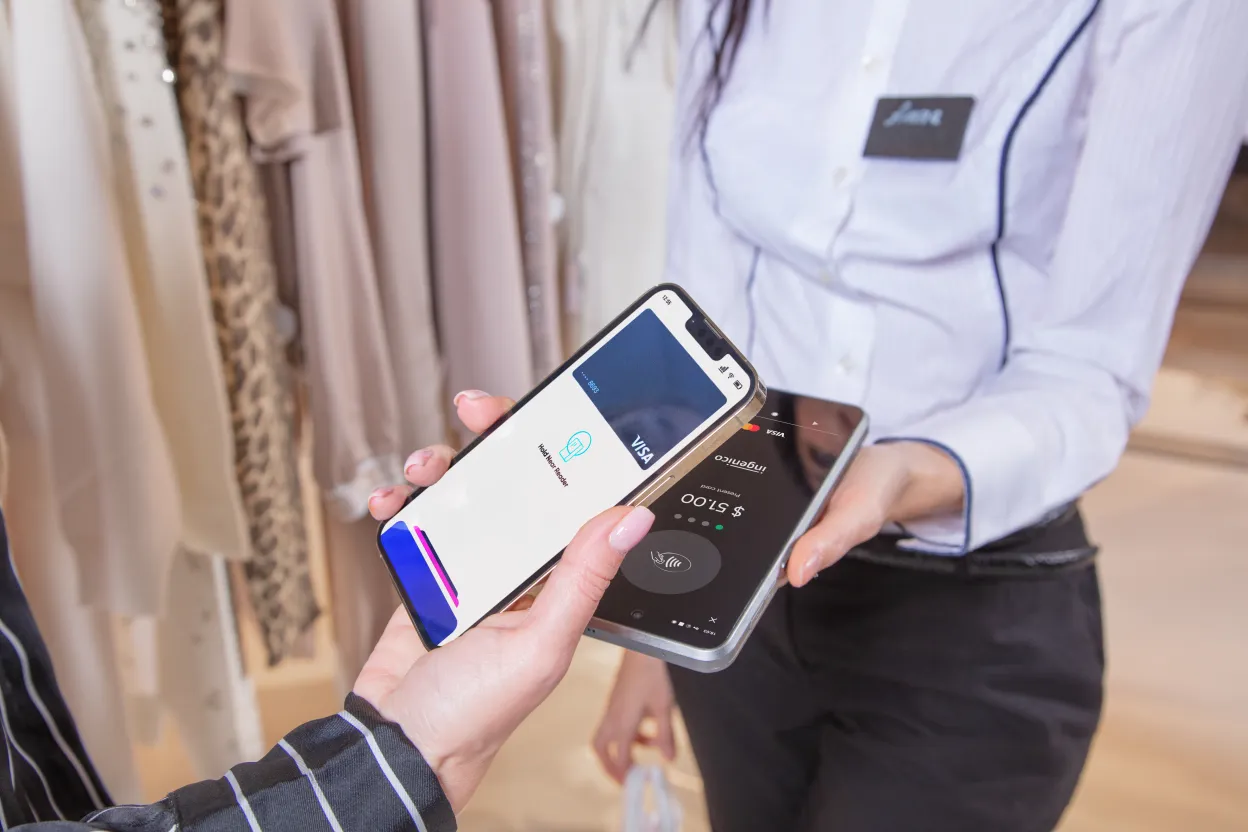
SoftPOS is a strong fit where payment follows the employee: tableside and curbside service, line-busting on the shop floor, deliveries and field services, events, and micro-merchants taking their first steps into card acceptance. It is also a natural choice for businesses whose staff already carry handhelds for other tasks.
Payment terminals remain the right choice where payment is the core of the interaction: high-volume counters, customer-facing PIN entry, unattended and self-service environments, receipt printing, all-day battery life and rugged use. Purpose-built devices are designed, certified and managed for exactly these conditions.
Most merchants of any size will need both. A grocery store may run AXIUM terminals at its lanes and SoftPOS on handhelds for queue-busting at peak hours. A restaurant group may use countertop terminals at the bar and SoftPOS on waiters' devices. The winning set-up is a single estate in which each device does the job it does best, integrated, managed and reported in one place.
What should you plan for in 2027 and 2028?
Based on where standards and customer demand are heading, we expect five developments.
Device selection will get more attention. Especially for larger merchants, payment providers will increasingly guide device choices based on read range performance and scheme guidance.
Mixed estates will become the norm. Merchants will combine terminals, SoftPOS and card readers according to each use case, and will expect a single integration, a single management console and consolidated reporting across all of them.
Integration will decide who wins. Merchants and ISVs will favor payment platforms that let them integrate once and deploy payment acceptance on any form of factor, rather than maintaining a separate integration for each device type.
Feature expectations will keep converging. Pre-authorization, offline resilience, alternative payment methods, and accessibility will meet standard expectations across every acceptance device, including SoftPOS.
Compliance costs will reshape the market. MPoC listings and SDK integration validation raise the investment needed to stay in the game. Solutions still relying on legacy approvals will face a harder path as scheme bridging arrangements expire.
How does Ingenico help?
No single deployment model fits every bank, acquirer, PSP, and ISV. That is why Ingenico SoftPOS is built as a set of building blocks, designed to work alongside Ingenico's payment terminals rather than in isolation.
White-label SoftPOS app
A ready-to-deploy payment app for Android and iOS, branded under the bank's or acquirer's own name. It is the fastest route to market for providers who want to serve merchants directly. Partners such as JCC Payment Systems in Cyprus and Tyl by NatWest in the UK have used Ingenico's white-label solution to accelerate their launch and reach small businesses that previously relied on cash.
App2App ECR interface
Many merchants already run a POS ordering, or field-service app on the same device they want to take payments on. With App2App, that business app simply sends the amount to the Ingenico SoftPOS app, which manages the card interaction and returns the transaction result. Sensitive card data never passes through the business app, which keeps it out of the payment security perimeter, while the merchant gets an integrated checkout with no double keying.
Isolated payment SDK
For ISVs and PSPs who want payment acceptance inside their own app, with a single user experience, Ingenico provides an isolated payment SDK. "Isolated" means the SDK protects its memory and sensitive assets from the host application, so partners can embed payments without their own app handling sensitive card data.
Core SDK for consistent integration across terminals and SoftPOS
For ISVs and integrators already working with Ingenico terminals, AXIUM Retail Core (ARC) offers a familiar path to SoftPOS. By integrating Ingenico's Core SDK, ARC makes the same API available on AXIUM terminals and on SoftPOS, helping partners reuse their existing integration work as they add new form factors to their merchants' estates. This includes integrators connected through Ingenico's legacy terminal APIs.
One last question: where does SoftPOS fit in your payment strategy?
SoftPOS is no longer just a backup. For mobile staff, service businesses, and first-time card acceptors, it is becoming an everyday way to get paid. But its growing role raises the bar: solutions must be listed under PCI MPoC, run on devices suited to the job, and deliver the features and integrations merchants expect.
The providers that succeed over the next 24 months will not treat SoftPOS and terminals as competing choices. They will offer both, on one integration, and help each merchant put the right device at every checkout.
Ready to build the right device mix for your merchants? Contact us to find out how Ingenico SoftPOS and AXIUM work together.
FAQs
SoftPOS can act as a full‑replace solution for a traditional terminal where contactless adoption is already high—for example, in regions such as Eastern Europe or parts of Asia where NFC usage is widespread. In those markets the software‑only approach can eliminate the need for dedicated hardware, giving merchants a flexible, cost‑effective checkout. However, in many other locations SoftPOS is positioned as a complementary option that augments existing terminals rather than outright replacing them, especially where contactless penetration is still growing .
Ingenico SoftPOS runs on any NFC‑enabled consumer or professional device that meets the OS requirements – Android 8.1 or higher (optimised for Android 11 and above) and iOS 16.4 or higher – so merchants can turn a standard smartphone or tablet into a secure, contact‑less terminal. It also supports rugged PDAs and dedicated Android‑based SoftPOS payment terminals, giving you the flexibility to use a personal device, a professional mobile device, or a purpose‑built terminal.
Ingenico SoftPOS safeguards payment and customer data by embedding enterprise‑grade security directly into the mobile app. The solution is built to meet the MPOC 1.1 certification and uses strong encryption, tokenisation and secure element techniques to protect card details during NFC, QR‑code or Open‑Banking transactions. All data is processed in a hardened environment on the device, and the platform enforces PCI‑compliant controls, ensuring that sensitive information never leaves the handset in clear text. This robust security framework lets merchants accept contactless payments on any Android or iOS device without exposing payment or personal data.
SoftPOS is rolled out centrally through Ingenico’s management portal, letting a merchant create a single SoftPOS account that can be shared across any number of NFC‑enabled Android 8.1+ or iOS 16.4+ devices. Each employee installs the app on their own smartphone or tablet, logs in with the shared credentials, and the portal handles device provisioning, configuration (branding, receipt settings, Bluetooth printer pairing, etc.) and ongoing updates—so teams can add or remove devices instantly without additional hardware.
This cloud‑based approach enables fast, scalable deployments and simple multi‑user management from a single console.
Ingenico SoftPOS lets merchants turn any NFC‑enabled Android 8.1+ or iOS 16.4+ smartphone or tablet into a secure, contact‑less payment terminal. It accepts the major card schemes – Mastercard, Visa and other international cards – through the device’s NFC reader, and can also generate receipts via email, SMS, QR‑code or a connected printer.