A Guide to the Current Biometric Payments Landscape
Listen to this article
Interest in biometric payments is increasing around the world, and consumers and merchants are discovering how easy it is to participate and use. Banks and acquirers that work with the right biometric payments solution provider partner will benefit in multiple ways, including new revenue opportunities, less fraud, lower support costs, and stronger security.
Biometric payments are swiftly gaining traction within the global market, which Fortune Business Insights projects will grow at a 16.20% compound annual growth rate (CAGR) from $11.54 billion to $44.69 billion by 2034. For banks and acquirers weighing whether to bring biometric payments into their merchant portfolios, that trajectory is hard to ignore.
Adoption is progressing at different rates in global regions:
-
Latin America shows the strongest momentum, driven by demand for security, convenience, speed, and growing digital payment adoption overall.
-
Europe and Asia are taking a more measured approach, with consumers and regulators placing greater emphasis on privacy, transparency, and data protection requirements.
-
North America is seeing growing interest, but privacy concerns remain a significant barrier. Consumers want assurance that biometric data is encrypted, protected, and remains under their control before they’re willing to enroll.
Across every region, however, one factor consistently drives adoption: speed. Biometric payments use a person’s unique physical characteristics to verify identity, ensuring only the authorized account holder can complete the transaction. That delivers meaningful security benefits, e.g., biometric credentials can’t be lost, forgotten, or easily shared like cards or PINs. But it’s the frictionless checkout experience that resonates most with consumers. Instead of reaching for a wallet or unlocking a phone, shoppers simply use their biometric credential to authorize payment. For example, with palm vein biometric payments, the customer only needs to hold an open hand over the reader, completing the transaction without a card, PIN, or additional authentication.
For banks and acquirers evaluating whether to offer biometric payments, understanding how enrollment, merchant acceptance, and implementation work in practice is the first step toward a confident rollout.
What Are the Steps Involved in Biometric Payment Enrollment?
While biometric payments continue to gain traction, they’re still a relatively new technology, but it’s easy to enroll and to use. Supporting biometric payment solutions for retail and other verticals is straightforward, and the enrollment experience is designed to be quick and intuitive for both consumers and the financial institutions offering it.
Enrollment generally follows these steps:
-
Initiate at a Kiosk
Enrollment can be completed entirely at a self-service kiosk, without requiring dedicated staff to guide customers through the process.
-
Verify Identity and Link an Account
The consumer verifies their identity and links a payment account. Connecting a single account keeps the experience simple while minimizing opportunities for error.
-
Scan Biometrics
The consumer scans the biometric credential required by the payment solution. Enrollment is typically a one-time process because biometric characteristics often remain stable over time. In the case of palm vein authentication, the consumer simply holds an open hand above a near-infrared scanner, which captures an image of the unique vein pattern beneath the skin.
-
Secure and Tokenize
The biometric scan is encrypted and converted into a secure token that links the consumer to their payment account for future transactions. The scan itself is stored in a secure cloud environment rather than on the merchant's local system.
Several types of biometric authentication can be used for payments, including facial recognition and palm vein authentication. Among today’s options, palm vein technology is often preferred because it combines strong security with a payment experience that feels intentional and reassuring to consumers.
Unlike facial recognition, which some consumers worry could identify them simply by walking past a scanner, palm vein authentication requires the deliberate action of holding an open hand over the reader to initiate a payment. That active gesture gives consumers confidence that they remain in control of when and how transactions occur while also benefiting from the speed and convenience of biometric authentication.
What It Takes for Merchants to Accept Biometric Payments
Just as enrollment is straightforward for consumers, accepting biometric payments is equally manageable for merchants, especially those that already have modern payment infrastructure in place, including Android-based payment terminals.
-
Add a Palm Scanner
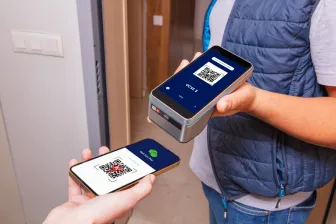
Merchants using an Android POS terminal, such as a device in Ingenico’s AXIUM lineup, can typically add a palm scanner that integrates with their existing payment setup rather than replacing hardware altogether.
-
Enable Biometric Software
Software is added to the payment terminal to support biometric enrollment and authentication, making deployment relatively lightweight for merchants and their IT teams.
-
Process Payments Over Existing Infrastructure
Once a payment is authenticated, the payment data is tokenized and processed over the same rails as an EMV card-present transaction. Merchants don’t need to adopt new settlement processes or reconciliation workflows, allowing biometric payments to fit naturally into existing operations.
For banks and acquirers, the key advantage is that biometric payments build on existing payment infrastructure rather than replacing it. For merchants already using Android POS terminals, enabling biometric acceptance can be a relatively straightforward extension of their current payment environment.
That same flexibility also benefits the broader payments ecosystem. ISVs and solution providers can develop biometric enrollment and payment applications that integrate with the terminal's existing app environment instead of requiring custom hardware integrations. For banks and acquirers, that means a growing partner ecosystem capable of accelerating deployments, expanding merchant choice, and bringing biometric payment solutions for retail to market more quickly.
What Banks Need to Know About Biometric Payment Security
Banks don’t need to reinvent their security posture to support biometric payments. The same foundational practices that protect today’s digital payment ecosystem also provide the framework for securing biometric transactions. This table includes key safeguards.
|
Security Feature |
Biometric Payment Solution |
|---|---|
| Tokenization | Sensitive biometric and payment data is replaced with non-sensitive tokens, ensuring the original information isn't exposed during a transaction. |
|
Encryption
|
Data is encrypted both at rest and in transit, consistent with the security standards already applied across a bank's digital payment infrastructure. |
|
Segmented Data Architecture
|
Biometric scans, payment tokens, and encrypted card data are stored separately, making it significantly more difficult for an attacker to correlate the information, and thus strengthening overall security.
|
|
Multi-factor Authentication
|
Access to the software and systems that support biometric payments is protected through multi-factor authentication, limiting who can configure, manage, or administer the environment. |
| Ongoing Monitoring | Dedicated security tools continuously monitor the biometric payment environment, helping banks identify and respond to potential threats before they become larger issues. |
Advice for Early Adopters of Biometric Payments
Biometric payments may be a relatively new payment method, but they’re designed to be simple for everyone involved, from consumers and merchants to the banks and acquirers supporting them.
By the time a biometric payment solution reaches a bank or merchant, much of the technical complexity has already been addressed by the technology provider. Success depends less on the technology itself than on delivering an experience consumers trust. Merchants can build that confidence by helping customers enroll the first time they encounter biometric payments and by integrating biometric acceptance seamlessly into existing checkout workflows.
For banks and acquirers, offering biometric payment solutions is an opportunity to differentiate while providing a user-friendly payment experience that is already delivering measurable value to merchants, including:
- Reduced Payment Fraud: Highly accurate identity verification helps reduce fraud and unauthorized transactions.
- Lower Support Costs: Fewer password resets, card replacements, and manual identity verification requests can reduce support demands.
- New Revenue Opportunities: Expanding payment capabilities creates new opportunities to deliver value-added services and strengthen merchant relationships.
- Stronger Security and Compliance: Robust authentication, tokenization, and encryption help support a stronger overall security and compliance posture.
Realizing these benefits starts with choosing the right technology partner. Banks and acquirers should look for a provider that delivers secure hardware, has deep expertise in GDPR and other data privacy requirements, and can simplify the implementation. The right partner reduces complexity, accelerates deployment, and helps institutions move from pilot to full rollout with confidence.
With decades of experience in payment technology and a trusted global presence, Ingenico helps banks and acquirers deliver secure, fast, and intuitive biometric payment solutions for retail and beyond.
Contact us to learn how Ingenico's biometric solutions can help your institution bring trusted checkout experiences to the merchants you serve.
FAQs
Biometric payment terminals are engineered for payment‑grade accuracy: they meet industry‑approved security certifications, incorporate hardware anti‑spoofing, and (especially with palm‑vein) use an internal biometric that is inherently harder to fake. While the exact numerical FAR/FRR values are not disclosed in the public assets, the documented compliance and technology choices indicate very low error rates suitable for high‑volume retail and financial‑inclusion deployments.
Palm‑vein scanning protects payments by using a deep, invisible vascular pattern that is extremely difficult to replicate, coupled with hardware anti‑spoof measures and PCI‑compliant encryption. This makes it intrinsically more resistant to cloning, photography, or presentation attacks than surface‑level biometrics such as fingerprints or facial recognition.
The data is treated as the customer’s personal data, processed after the customer gives explicit consent and, whenever possible, stores it on‑device (local to the terminal or smartphone) rather than in a central cloud. This aligns with GDPR requirements that the data subject retains ownership and control. The authentication decision is performed locally on the POS terminal or the customer’s device (e.g., the palm‑vein sensor or fingerprint module). The terminal validates the biometric sample against the locally stored template and only then authorises the payment. No external party decides the outcome. Merchants get a masked receipt for audit purposes, but they never receive the raw biometric data or the authentication result. The data stays with the customer (or the device) and is deleted if the customer revokes consent.
Yes – Ingenico’s biometric payment data is designed to be highly secure. The biometric template is stored only on the terminal in an encrypted form and never leaves the device, so even if the terminal is compromised the raw biometric cannot be extracted. End‑to‑end encryption and strict PCI‑DSS compliance protect the payment credentials that are unlocked by the biometric check. Under‑the‑hood, Ingenico’s key‑injection and cryptographic key‑management processes ensure that all keys used for encryption are generated, injected and stored in a tamper‑resistant hardware security module. The Palm‑Vein solution specifically highlights how the biometric scan is performed locally and how the terminal’s built‑in anti‑skimming sensors and secure firmware further guard against fraud.
Biometric payments give merchants a powerful tool to reduce fraud, speed up checkout, and reach new customer segments, while the primary risks are privacy compliance, implementation cost, and occasional usability hiccups—all manageable with proper processes and the support resources Ingenico provides.