How Retail Payment Solutions Can Support Digital Currency
Listen to this article
Digital currency is emerging as a potential retail payment option, with flexible technology, new regulations, and potential benefits driving interest. Banks and payment acquirers should prepare to meet demand by implementing flexible payment infrastructure that can support emerging methods, including QR-based digital currency acceptance.

Technology, consumer, and regulatory trends indicate that retail checkout capabilities will expand to include digital currency payments. Although most consumers aren’t requesting to pay with their stablecoin wallets today, momentum is building to bring this payment option to stores.
To stay on the leading edge, banks and acquirers that offer payment solutions for retail should explore their options now and plan to accommodate merchants and consumers when demand increases. Deloitte predicts that more than $200 billion of U.S. retail payments will be stablecoin-enabled by 2030, when digital currency acceptance could gain a foothold as a part of the payments ecosystem.
The Technology Behind Digital Currency Acceptance In-Store
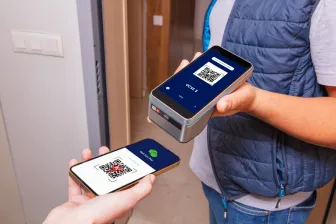
With the right payment technology, supporting digital currency payments at the point of sale does not mean deploying new terminals. Merchants can use an app that runs securely on the terminal to orchestrate the transactions. Ingenico has determined that the optimal payment flow follows these steps:
|
Step |
Payment Process |
|---|---|
| 1 | Merchants total sales as if they are accepting fiat currency. |
| 2 | Customers choose the option to pay with stablecoin. |
| 3 | Customers use their smartphones to scan a QR code at checkout and use their stablecoin wallets to pay. |
| 4 | The payment terminal will show when the stablecoin issuer/exchange completes the transaction. |
| 5 | The retailer receives the value of the sale in fiat currency via fiat on-ramps. |
| 6 | Fiat currency is deposited in the merchant’s account, often within minutes. |
This model decreases complexity for the merchant, eliminating the need for them to directly interact with stablecoin exchanges or issuers. Furthermore, banks and acquirers will benefit from partnering with a payment technology provider that makes stablecoin transactions as flexible and user-friendly as possible. For example, Ingenico’s solution allows consumers to use the stablecoin wallet of their choice and use a fast blockchain to ensure that transactions are as quick as other forms of digital payments. Funds settle immediately, with no need for merchants to manage cryptocurrencies. The terminal itself is also a key part of the solution, particularly for offline transactions. The terminal will become a “vault,” storing the value of the transaction until connectivity is restored and the funds transfer can complete. The terminal that you choose for payment solutions for retail will become integral to business continuity and security when merchants begin to accept digital currency.
Who Will Be In-Store Digital Currency Transaction Trailblazers?
Banks and acquirers will likely see demand for payment solutions for retail grow first in certain markets. Global cryptocurrency exchange Paybis estimates that 559 million people worldwide currently hold or use cryptocurrency. The Asia-Pacific region has the highest adoption rate with approximately 350 million users. Europe follows with about 140 million users, and North America is closely keeping pace with about 140 million users. Paybis also sees age as a differentiator, with the average age of crypto users around the world at 34.8. Crypto adoption is strongest among men who live in urban areas.
However, these statistics represent people who use cryptocurrency for all uses, from savings and investment to trading, gaming, and cross-border remittances. It is likely that consumers who are most likely to use stablecoin wallets in physical stores will be those who are most familiar with cryptocurrency. Although analysts see rising Gen Z consumers as a potential force, it may be today’s millennial crypto holders who are the first to make purchases in-store with stablecoin.
Digital Currency Payment Benefits that Could Drive Adoption
Whether merchants see the value of using this new payment option will determine how quickly it becomes part of the payments ecosystem. However, paying with stablecoin has several potentially appealing capabilities:
- Faster settlement. Stablecoin transactions can settle in minutes. Merchants who wait days for funds transfer could see improved cash flow by accepting digital currency.
- Competitive processing fees. Merchants may find that accepting stablecoin is a cost-effective alternative to traditional methods.
- 24/7 availability. Digital currency transactions can take place at any time, including weekends and holidays.
- Blockchain transaction records. Digital currency transactions create a visible record on a blockchain, giving merchants accurate data in real time.
- International customers. Digital currency can provide a way for businesses to transact with travelers and international customers who may not have access to local currency or want to avoid fees for using payment cards from other global regions.
As the payments space continues to evolve, digital currency acceptance in physical stores may be a positive move for merchants.
Regulatory Developments Creating Greater Clarity for Digital Currency
North American legislators and regulatory agencies have taken steps to protect merchants and consumers choosing to transact in stablecoin. In the United States in 2025, the GENIUS Act established federal requirements for permitted payment stablecoin issuers, including required reserves. Canada enacted its Stablecoin Act in 2026, providing a federal framework for oversight of fiat-backed stablecoin issuers, with the Bank of Canada as the regulating authority.
Regulations do not guarantee adoption. However, they bring some clarity to how stablecoins could become a part of the payments landscape by minimizing risks and adding safeguards.
Prepare to Take Payment Solutions for Retail to Market that Support Digital Currency
Constantly evolving technology, consumer behaviors, and merchant demands require banks and acquirers to implement technology that can adapt and scale with the industry. With the right payments platform, banks and acquirers don’t have to gamble on solutions that support one payment method. A flexible, extensible platform allows them to position themselves for whatever lies ahead.
Ingenico's AXIUM Android payment platform enables merchants to run business applications, such as Ingenico’s app that allows consumers to use their choice of stablecoin wallets and to connect to the point-of-sale system via QR code. Ingenico’s solution takes the burden of managing cryptocurrencies from the merchant, making transactions as easy as those that use fiat currencies. It is also fast and designed with terminals that act as a vault to securely support offline transactions.
Furthermore, AXIUM is designed with the flexibility to accept the full range of payment types, both popular and emerging, such as mobile wallet payments, buy now, pay later (BNPL) payments, biometric payments, and even SoftPOS, which allows merchants to accept contactless payments on near-field communication (NFC)-enabled mobile devices without an additional card reader.
Partner with Ingenico to offer payment solutions for retail that adapt to the changing payments landscape. Contact us to learn more.
FAQs
Alternative Payment Methods (APMs) refer to any form of payment that falls outside traditional credit and debit card transactions. These include digital wallets, Buy Now Pay Later (BNPL) services, QR code payments, mobile payments, cryptocurrencies, and other regional or emerging payment solutions. APMs are becoming increasingly popular due to their convenience and flexibility for both consumers and merchants.
Visit our dedicated Alternative payments page.
Android POS terminals (AXIUM Android) run a unified Android OS that can host any payment‑application that follows the device’s SDK, so merchants can install and run local or alternative payment apps (e.g., QR‑code wallets, NFC‑based contactless schemes, country‑specific mobile wallets, prepaid or voucher solutions) side‑by‑side with traditional EMV card apps. Because the platform is open, the same terminal can present the customer with multiple payment options on the screen, route each transaction through the appropriate gateway, and settle them in a single flow—letting you accept cards, local digital wallets, QR‑based payments, and other emerging methods without needing separate hardware.
Ingenico supports a comprehensive range of Alternative Payment Methods (APMs) to meet evolving consumer expectations. These include digital wallets like Apple Pay, Google Pay, and Samsung Wallet; QR code-based payments such as Alipay and WeChat Pay; Buy Now, Pay Later (BNPL) options like Klarna, Clearpay, and Afterpay; as well as gift cards.
By offering such a wide variety of APMs, Ingenico helps merchants create a more inclusive and flexible checkout experience for customers across all regions.
Learn more
Ingenico terminals support a broad range of Alternative Payment Methods (APMs), providing businesses with flexible and secure payment options. These include popular digital wallets such as Apple Pay, Google Pay, and Samsung Pay, as well as QR code payments through services like Alipay and WeChat Pay. Ingenico also enables the acceptance of Buy Now Pay Later (BNPL) solutions, including Klarna and Afterpay, offering customers greater flexibility in payment options. Additionally, Tap to Phone functionality allows businesses to use smartphones as point-of-sale terminals. Ingenico terminals also support a variety of local payment methods depending on the region. With this comprehensive support for APMs, Ingenico helps businesses cater to diverse customer preferences and enhance the payment experience.
Contact us to learn more.
Through a combination of remote updates, centralized fleet management, a common software framework, and a unified device portfolio, Next-Gen AXIUM helps simplify deployment, maintenance, and device management.